
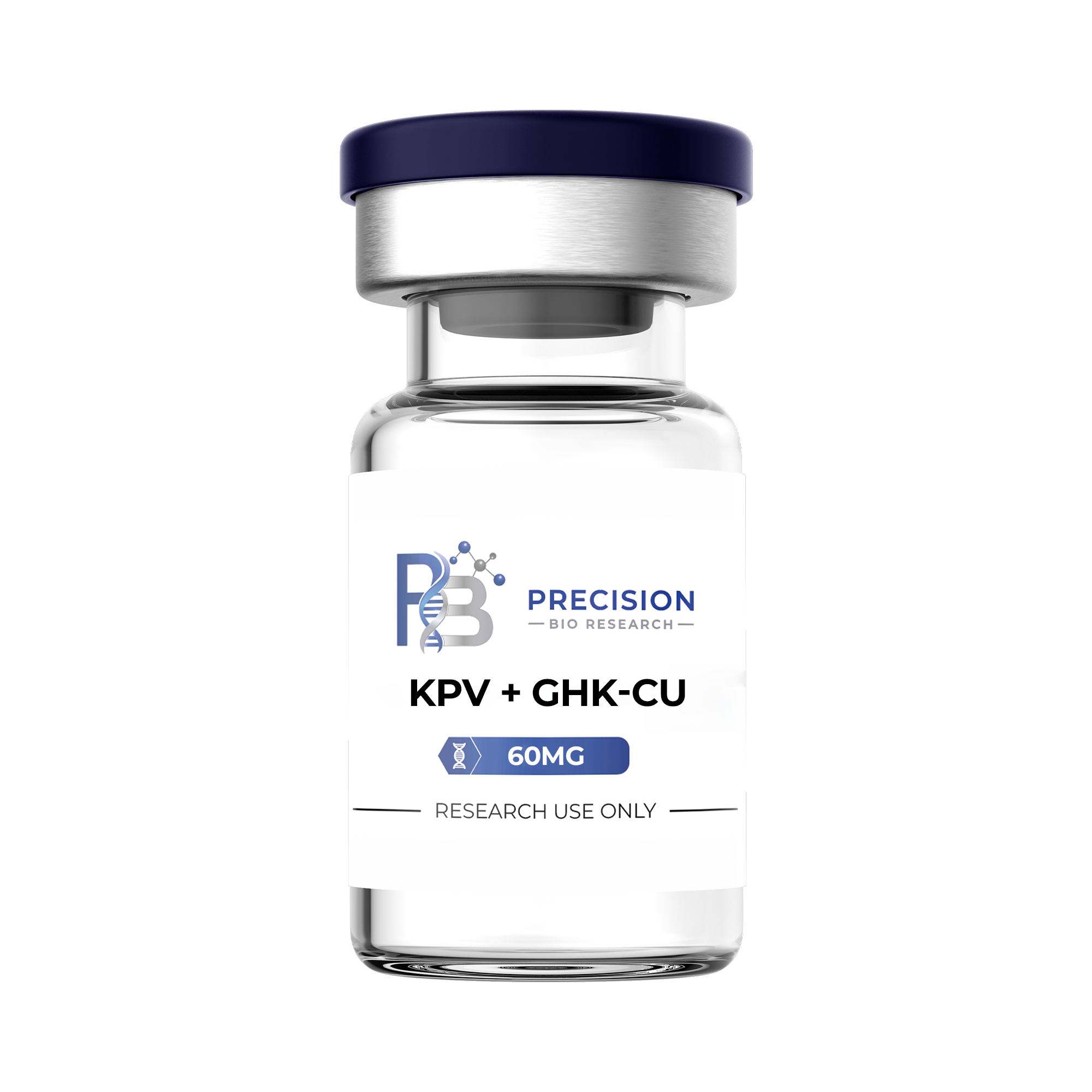
Product Specifications
Form: Combined lyophilized peptide powder
Total Strength: Add the product-specific total strength
Component Ratio: Add the verified KPV to GHK-Cu ratio
Product Classification: Synthetic dual-component peptide and copper-peptide research blend
Component One: KPV
KPV Peptide Length: 3 amino-acid residues
KPV Sequence: Lys-Pro-Val
KPV Classification: Synthetic tripeptide research compound
KPV Molecular Formula: C₁₆H₃₀N₄O₄ for the free peptide form
KPV Molecular Weight: Approximately 342.44 g/mol for the free peptide form
KPV CAS Number: 67727-97-3
Component Two: GHK-Cu
GHK-Cu Peptide Length: 3 amino-acid residues
GHK-Cu Sequence: Gly-His-Lys coordinated with copper
GHK-Cu Classification: Synthetic copper-binding tripeptide research complex
GHK-Cu Molecular Formula: C₁₄H₂₂CuN₆O₄ for the anhydrous copper complex
GHK-Cu Molecular Weight: Approximately 401.93 g/mol for the anhydrous copper complex
GHK-Cu CAS Number: 49557-75-7
Molecular Formula: No single molecular formula applies to the complete blend
Molecular Weight: Each component has an independent molecular weight
CAS Number: No single CAS number applies to the combined formulation
Purity: Each component should meet the stated purity specification where confirmed through batch-specific analytical testing
Appearance: Blue to blue-green lyophilized powder, depending on GHK-Cu concentration and formulation
Intended Use: Laboratory research and analytical applications only
Research Applications
- Analytical separation and characterization using HPLC, UPLC, and LC-MS workflows
- Investigation of copper-peptide coordination within a combined formulation
- Comparative evaluation of KPV, GHK-Cu, and the complete peptide blend
- Study of peptide-associated molecular interactions under controlled assay conditions
- Assessment of component identity, concentration, purity, and formulation ratio
- Spectroscopic evaluation of copper coordination and complex stability
- Stability profiling under defined temperature, pH, buffer, light, and storage conditions
Quality Documentation
A batch-specific Certificate of Analysis and applicable analytical documentation should be available for each lot. Documentation should confirm both component identities, peptide sequences, individual strengths, blend ratio, purity results, molecular weights, salt forms, copper content, formulation details, and batch identification. Molecular characteristics may vary according to counterions, hydration state, copper coordination, and the final formulation.
For Laboratory Research Use Only
This product is intended exclusively for controlled laboratory and in vitro research. Not for human or veterinary use. Not for diagnostic, therapeutic, clinical, cosmetic, personal-care, or household applications.
Reviews
There are no reviews yet.